Welcome - Please Read

Welcome. I wanted to provide stripboard layouts I've made to help people new to electronics and even the more experienced get into different aspects of electronics.

I verify the layouts before I post them.

My Facebook Group: www.facebook.com/StripboardLayouts - Please Add For Updates!
My Twitter Thing: @InSonicBloom

Showing posts with label Misc. Show all posts

Tuesday, 4 August 2020

Why I Rarely Post Projects Anymore


Alot of my projects are things I've thought of (unless otherwise noted) and over the years I've gotten a bit pissed off with people building my stuff, selling it on without even bothering to credit me in anyway. I don't care if people build/sell this stuff but one of the unwritten rules of open source stuff is that you always credit the original person.

I've seen many of my projects floating around being sold by various people with no mention or link to where it came from and it put me off sharing stuff so I simply stopped bothering putting effort into posting here. But seeing this on eBay was the straw that broke the camels back. 

people within "open source" give you stuff they've spent time and money developing - the very least you can do is respect them enough to link to the original post and/or credit them ESPECIALLY if you're making money out of them.

behringer-uv300-Mod


Saturday, 26 December 2015

Piss Off batteriser


when doing the admin part of this site,nothing infuriates me more than having a company trying to advertise their snakeoil products in the comments section.
I often get comments where someone has copied a bit of the text from my blog post and then shoved a link to some crappy product after it and usually I just delete it but given the fact that Batteriser has been so underhanded and dishonest about everything they do and claim - I thought I would call this one out.

Dave Jones from the EEVblog has debunked their product in just about every way imaginable and they've done some hilarious reply videos to him where some "engineer" is sat at a table with an oscilloscope hooked up to its own 1Khz reference/cal signal (with very badly compensated probes), some wires and boards and a suspiciously new and cheap looking soldering iron; explaining why Dave is wrong. then, when that failed they just paid people to downvote his videos.

so Batteriser, do not advertise your shitty, useless products on my site.


Daves Videos

Friday, 24 April 2015

Proper Op Amp Termination


I've been designing a sampler recently (sorry, there won't be a stripboard for that, it's way too complicated!) however I was using a quad opamp for a part of it but I only needed 3 of the op-amps which gave me the idea to post a little tutorial on the correct way to terminate unused op-amps and a brief explanation why (I'm sure there are very in depth youtube videos/documents elsewhere)

the extremely brief reason to terminate a op-amp correctly is that it may draw extra current or it will pick up noise (or both)


Tuesday, 7 April 2015

Saturday, 5 July 2014

Mains Failure Alarm Stripboard Layout


I have a fish tank and in it - lives many tropical fish - however the other day the plug socket switch the heater was plugged into somehow got knocked off. luckily I noticed the heaters light wasn't on and the water temp hadn't dropped so the fish were safe however I wanted to make a little device to warn me if the mains got turned off somehow without having to wire it to the mains directly.

So here we have a little device that starts beeping if the mains is turned off - obviously this is battery powered but the battery should last a long time because it's very low current draw.

the trim pot on the board adjusts the sensitivity of the antenna which is just a piece of wire than you wrap around the cable you want to monitor.


Wednesday, 9 April 2014

Guitar Lead Muting Studio Aid


I've had this little box stuck to the side of my bench for quite a while to plug various leads into while they are out of use but still plugged into amplifiers/fx or other studio stuff to basically stop the equipment buzzing at me. My friend said it might be useful for other people so I'm sharing it here.

What is it?
a little box which is essentially a jack plug socket with a 47ohm resistor across it.

Its uses:
a lot of my guitars have active pickups so you can't just leave the lead plugged into them and leaving the lead on the floor buzzing away while you're messing with with a song is a big annoyance

I also have a few different FX chains that need to be isolated from each other so this comes in handy then as well.

The little box is at arms reach so I can just grab the lead easily and not have to twist my back reaching for the bugger.


Friday, 3 January 2014

PCB Silkscreen Designators


this isn't a stripboard post for a change (though one is coming soon). however it is useful to know what I'm about to write if you salvage parts or want to fix electronic items.

on PCBs (and other electrical installations) you will often be confronted with silkscreen designators like shown below (the white writing on the board)

here is a list of what each abbreviation stands for.

A - Separable assembly or sub-assembly (e.g. printed circuit assembly)
AE: Aerial, antenna
AT - Attenuator or isolator
BR - Bridge rectifier
BT - Battery
C - Capacitor
CR: Diode (see D)
CRT: Cathode ray tube
CN - Capacitor network
D - Diode (including Zeners, thyristors and LEDs)
DL - Delay line
DS - Display
DSP: Digital signal processor
F - Fuse
FB or FEB - Ferrite bead
FD - Fiducial
FL - Filter
G - Generator or Oscillator
GN - General Network
GDT: Gas discharge tube
H - Hardware
HIC - Hybrid Integrated Circuit
HY - Circulator or Directional coupler
IC: Integrated circuit (see U for link)
J - Jack (least-movable connector of a connector pair) | Jack connector (connector may have "male" pin contacts and/or "female" socket contacts)
JP - Link (Jumper)
K - Relay or contactor
L - Inductor or coil or ferrite bead
LA: Lightning arrester
LS - Loudspeaker or buzzer
LCD: Liquid crystal display
LDR: Light-dependent resistor
LED: Light-emitting diode
M - Motor
MCB: Miniature circuit breaker
MK - Microphone
Mic: Microphone
MOV: Metal oxide varistor (See RV for Link)
MP - Mechanical part (including screws and fasteners)
Ne: Neon lamp
P - Plug (most-movable connector of a connector pair) | Plug connector (connector may have "male" pin contacts and/or "female" socket contacts)
PS - Power supply
PLC: Programmable logic controller
PZ - Piezo Buzzer
Q - Transistor (all types)
      FET: Field-effect transistor
      JFET: Junction gate field-effect transistor
      MOSFET: Metal-oxide-semiconductor field-effect transistor
      BJT - Bipolar Junction Transistor NPN PNP HBT
      

R - Resistor
RL - Relay
RN - Resistor network
RT - Thermistor
RV - Varistor
S - Switch (all types, including push-buttons)
SCR - Thyristor
T - Transformer
TC - Thermocouple
TH - Thermistor
 - types of thermistors are..
   PTC - Positive temperature coefficient - the resistance rises with increased heat
   NTC - Negative temperature coefficient - the resistance decreases with increased heat

TUN - Tuner
TP - Test point
U - Inseparable assembly (e.g., integrated circuit)
V - Vacuum tube - Or VALVE!
VR - Variable resistor (potentiometer or rheostat)
X - Crystal
Y - Crystal or oscillator
Z (or ZD) - Zener diode
    
IEC Mains connectors (image from unknown - if you know let me know so I can cite)


Friday, 25 January 2013

9v Fast(ish) Battery Charger Stripboard Veroboard Layout


most of the chargers I own don't work fast enough - they take in the order of 14 hours so I thought "why not make one" since I have about 30 things with chargeable 9 volt batteries in them it would be nice to make a few of these. Anyway I wanted to make one that automatically cut off but it got a bit messy so I figured I would just drop the amount of current going into the battery so I could just leave it going for a few hours.

to work out charge time: hours = mAh / mA
example case: a 9v battery I have is rated at 150mAh
150 \ 50 = 3
therefore 3 hours

the LED illuminates when the battery is connected

the Transistor (BD135) needs to be heatsinked but the LM317 doesn't so if you're using a metal case you could just screw the transistor to the case and use that as the heatsink


Friday, 28 December 2012

Making A Current Blasting Power Supply With Old ATX Power Supplies


what is Current Blasting? I hear you ask..
Well sometimes when you have a fault with a piece of equipment it's not always easy to track down the issue - it usually comes down to a failed component that has shorted internally - a single failed component of possibly thousands so one method of tracking it down is blasting it with high current (at a low voltage)
It is quite a fun method of trouble shooting because most of the time the failed component explodes off the board, starts smoking or gets very hot.
so what's the best method of doing this? well get a high amp power supply which costs loads of money OR make one out of an old computer power supply.
You have probably seen people make power supplies out of these before for powering their projects which I don't personally think is that great of an idea because of the high current involved but you can use it for that if you wish.

The reason why these things are great for current blasting purposes is because the junked one I have (which is from a very cheap case that had a power supply on it) has a 5volt rail of 27 amps, a 12 volt rail of 13 amps and a 3.3volt rail of 25 amps. which as you can imagine is more than enough.

now for the usual "danger" crap...
I'm sure by now you're used to reading disclaimers and warnings to the point of being desensitized by it and it is easy to ignore these things.
but these things can be very dangerous so you need to take a lot of care when building/hacking these things. They have a lot of capacitors which may retain high energy even when the unit is unplugged. you NEED to make sure they are discharged before you start handling it - that goes for the filter capacitor on the IEC mains input - sometimes they don't have a bleed resistor and can discharge 240 volts (or whatever your local voltage is) into you which I can assure you bloody hurts.

2 Things you must be aware of to use these things

1. in order to switch it on you need to solder the Green wire to Ground (black wire) I suggest
doing this by means of a switch. The green wire will be labelled "PS" or "PSON" on the main PCB

2. some ATX power supplies need a minimum load to function which is around 200mA
to achieve this you must bridge the 5 volt and Ground terminal with a 22Ω resistor.

if you're interested in how this was worked out you can use ohms law
R(resistance)=V(voltage)/I(current) so you type into your Calculator
5 / .200 = 25 so you have the answer 25Ω and you round down to your nearest value which was 22Ω in my case


Anyway here are some pictures, if you have any questions don't hesitate to ask. 


Bare ATX PCB
very cheap supply I found in my shed


I found this on the net some time ago, I'm not sure who it belongs to so if it's yours let me know and I will credit you and your site

Monday, 10 December 2012

How To Work Out Parallel Resistance (If You're Completely New To Theory And Don't Get Maths)


First of all you need a Scientific calculator to "play along" I know the one in windows is adequate if you don't have one, I'm not sure what the Mac one is like but I'm sure it will be fine. I personally use a Casio Fx-7000G - it's from the 80's and it's ace - go on eBay and try and find one. I'll put a picture of it below.

Hope this helps anyone who has struggled with it.

Once you Have grasped it you can go test your skills HERE


Ignore the Numbers That's Nothing To Do With This Article

Monday, 29 October 2012

Behringer UV300 Rate Mod (Slow Down)


I thought I'd take a quick venture into modifying a effects pedal. The one I chose was the Behringer UV300 ( Ultra Vibrato ) I love Behringer gear and in most cases they do a really good job at effects and pretty well everything they put their minds to (see the X3!)
anyway I bought this on a whim cause it was very very cheap, I didn't even bother looking for samples because if I'm honest there is only so many times one can watch people doing out of tune covers of Lucy In The Sky With Diamonds while reviewing Vibrato pedals - also they never turn the rate down to nothing to show you how slow it goes.

as you can probably tell by this post, the "rate" didn't go as slow as I wanted, I like that sort of hypnotic warped record vibrato which this pedal couldn't do however with a little knowledge of how oscillators work and a bit of time probing around with a scope I was able to modify this to go slow enough

In order to slow down the range of the Rate control you basically just have to add capacitors in parallel with C12 and C15 - or you can swap them completely for higher values - the higher you go the slower it is however you need whatever capacitors you add to be very close in value to each other because if one is very different you get an uneven vibrato.
anyway here are the pictures.

if you have any questions - ask!

and you don't need to rehouse behringer pedals, the plastic is very strong - it easily withstands being dropped down stone stairs many times.


solder very quickly otherwise you'll be resoldering SMD stuff!

it's a good idea to do this in order to tailor it to your preference

the part of the circuit I am changing
The Behringer UV300 with its nice new switch

Thursday, 16 August 2012

Saturday, 14 July 2012

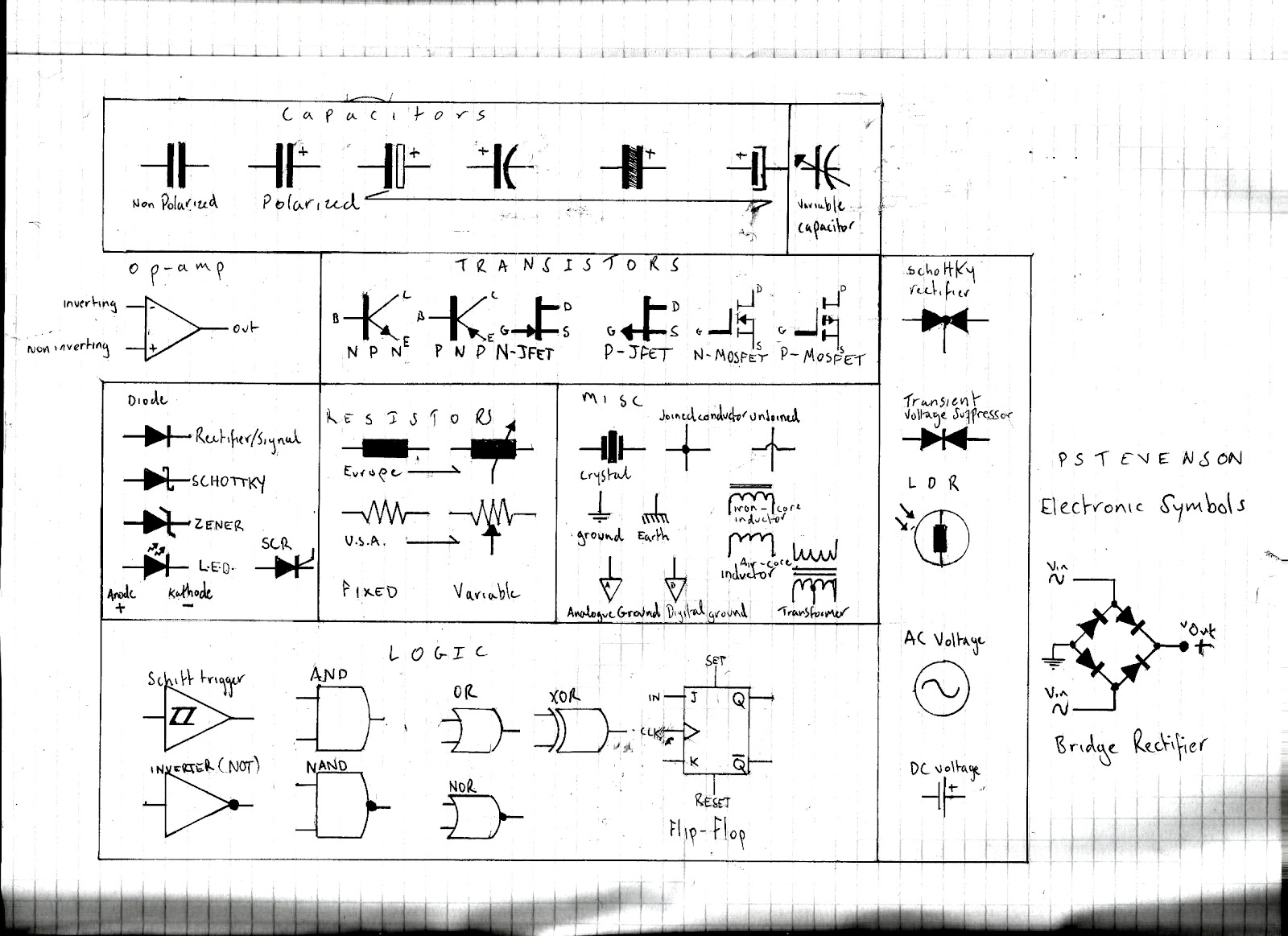
Electronic Symbols

I've been quite unwell so I have been unable to face firing up the soldering iron, I've just been lying in bed feeling sorry for myself - I do have a few layouts but they aren't verified yet so I won't post them yet. however I did sit in bed drawing out some of electronic symbols I use the most (and by extension everyone else should too!) so I will share the scan here - hopefully people will find it useful.


Saturday, 16 June 2012

Article on "the next decade" from 1975, from the magazine Practical Electronics


I found some old electronics magazines in my Great Uncles loft after he died which I kept, whilst reading through them I came across this fantastic article about the next decades advance in electronics written by readers so I just had to scan it - open in new tab/window to view it properly


Wednesday, 13 June 2012

A Word On My Schematics and a 10 Hour Timer


Some of you older people (my age and older) may notice that some of my schematics resemble that of the old Forest Mimms schematics IE, drawn on graph paper. This, of course is on purpose.

When I was growing up I would often spend a lot of time in the electronics shop Tandy (Radio Shack in the US), it had actually gotten to the point where the shop assistants knew me (I was about 7) and would even look after me while my mam went shopping. The electronics educational books they had were all the forest mimms ones so they'd let me sit in the corner reading them so I have a lot of fond memories attached to the Forest Mimms books which is why as an alternative to drawing my circuits out in EAGLE (which I have with some of them) I would pay homage to Forest Mimms and use his method of hand drawing schematics on graph paper. not only that but it really is a great way of drawing schematics. using a CAD program is all well and good but it takes longer and you end up with computer blindness if you do lots at once.

The one little bit I've added to make it my own and because when reading schematics I hate having to look them up, is adding little pinout drawings of any discretes and/or ICs used

Anyway back in school I designed this little circuit after my dad moaned at me for being on the phone to my girlfriend of the time for too long. there's no veroboard layout because I did this with wire wrap - in fact it was just not practical to use stripboard for this circuit because it would have ended up being hundreds of jumpers.


Friday, 1 June 2012

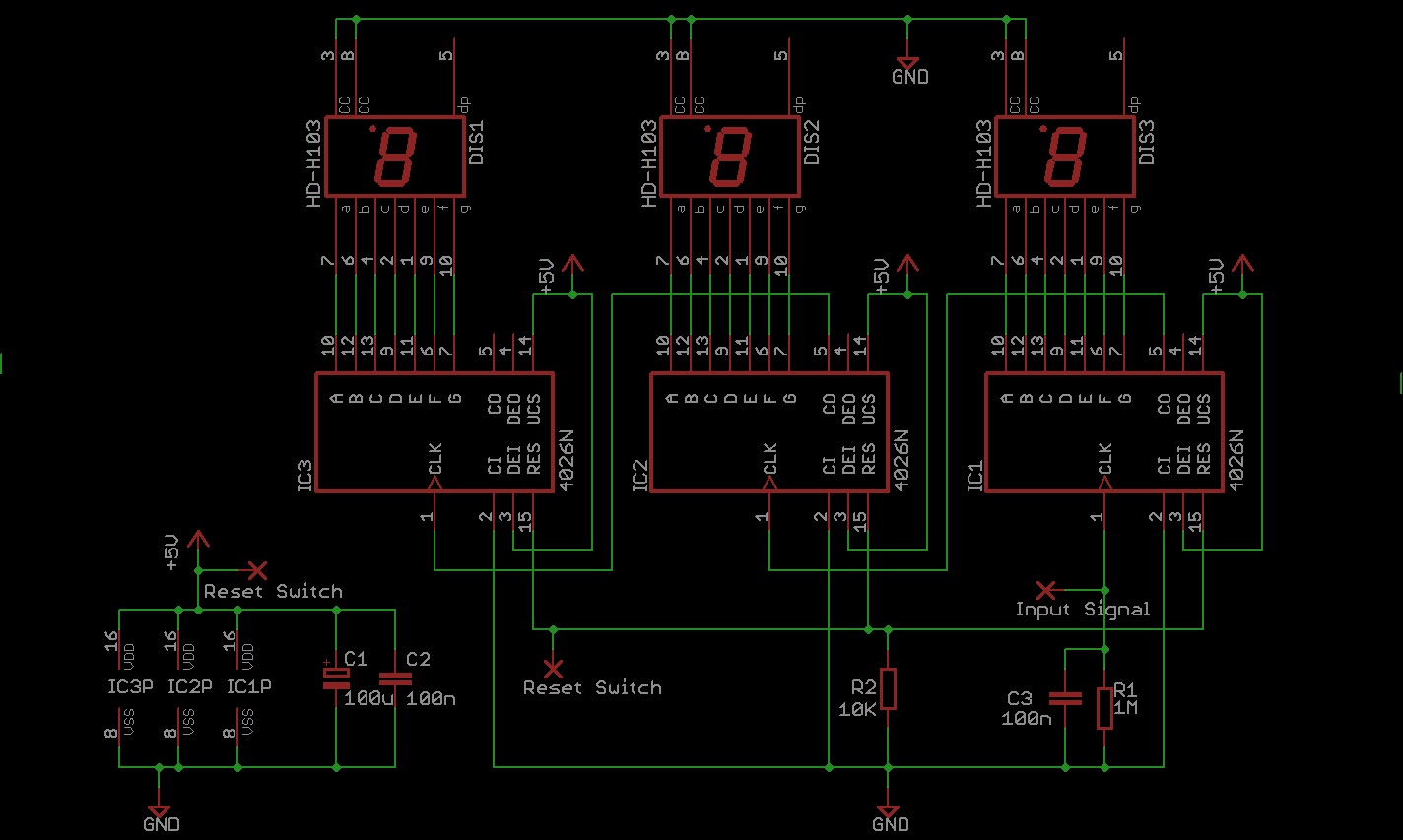
LED Display UP Counter Stripboard Veroboard (CD4026)


I wanted a counter that would basically count from a input signal, such as a reed relay to count the turns when winding a transformer or inductor for example. so I came up with this. I limited it to 3 digits (so it counts up to 999) because I only had veroboard big enough for that many but technically I don't think there is a limit to how many you can cascade because the CD4026 basically counts to 9 and sends out a clock signal on ten to the CLK in on the next chip

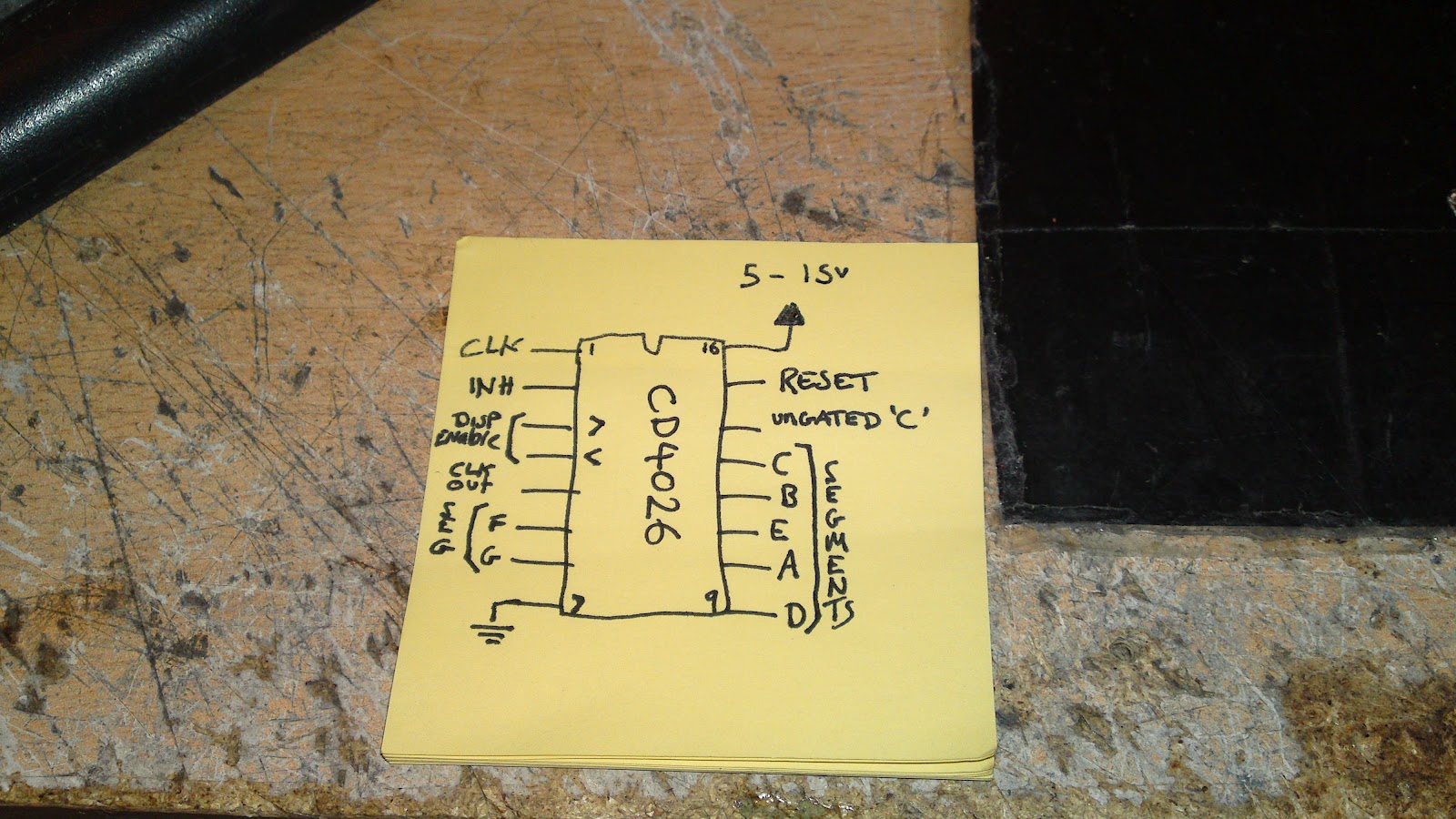
quite a simple circuit in theory but a pain in the arse with the jumpers and stuff, in order to try and save space I made jumper rails  with little wire hooks which I've drawn on a little post-it note to try to show you what I mean, though I do tend to put the jumper a lot closer to the board than the diagram shows of course!

while building this up, I came across the issue where if I touched it, it would start counting up rapidally - this was because my body was acting as an antenna for 60Hz mains hum which can be an issue sometimes so I added a little R C bit to stop this and this also served to make it reliable when using a push-to-make switch to count on it.

if you want the exact LED displays I used it was this one LED DISPLAY but any common cathode display will do as long as the pinout is the same (shown below


Thursday, 3 May 2012

The "In The Lab" Part


I always like seeing peoples workspaces so I thought I would post a picture of mine.I'm always on the lookout for interesting electronic equipment, most of which is elsewhere - the things you can see are the things I use most.

The Shed (a rant)
I also took a picture of the junk shed - this is where everything that doesn't work, that people have given me goes until I need a part from said item. the reason there is a polite sign to potential thieving bastards on my shed is because a few years ago some twat broke in about 3 times because the allure of electronic stuff he/they could sell for drugs was too tempting, I actually ended up constructing a nail board, it was a flat plank of wooden flooring with about 50 3" nails sticking up out of it, my reasoning being that everytime my shed was broken into it was dark and I would gain at least a little payback for the inconvenience of reattaching my goddam shed door everytime they came back, my plan worked, the next time they broke into my shed there was a very loud scream, needless to say nothing was stolen and they never returned after that.
people kept saying that I would get into trouble if I left my little bed of nails and someone stood on it but I maintain, I have the right to keep anything within the law inside my shed (nails are not illegal and nor is flooring)  and if someone happens to go into that locked shed there may happen to be a bed of nails that I keep on the floor inside my locked shed, either way no police came around to arrest me - they didn't come around when I reported for the 4th time some bastard was breaking into my property either.


my shit attempt at mixing 3 pictures together to get the whole thing in shot


Hameg dual function generator and ATTEN scope


lots and lots of cool circuit boards in these boxes
the sign reads: dear no-user robbing bastards, all items in this shed are broken and not worth anything - FUCK OFF

the rusty nail is rusty cause the guys blood made it go rusty.

Tuesday, 1 May 2012

The Amp Hour Podcast

a brief moment away from veroboards and such
if you're interested in electronics based chat - this is a fantastic online radioshow
hosted by Chris Gammell and Dave L. Jones (mentioned in this blog a couple of times)
The Amp Hour  


of course there is a personal gain for me to promote this (other than the fact I like the show and think everyone should listen to it - and everyone feels warm and fuzzy when they are listened to) since episode 76 they have used the theme tune that I wrote for them
you can hear the full song here


Monday, 30 April 2012

Valve UberScreamer Pedal

Sorry, couldn't resist


Arduino (for extra blog cred) Stripboard Veroboard


I did this sometime ago when I was flirting about with uControllers, needless to say I grew bored of them pretty quickly because it's not really electronics, it's programming and I hate programming however I did a few projects that I wanted to keep and make permanent so I did a stripped down veroboard of the Arduino board. essentially it powers and allows you to interface with the uController I/O's - has a "sketch" reset switch, a main power LED and a flasher LED (if you want to run the LED flasher "sketch")