Pages
Welcome - Please Read
Welcome. I wanted to provide stripboard layouts I've made to help people new to electronics and even the more experienced get into different aspects of electronics.
I verify the layouts before I post them.
My Facebook Group: www.facebook.com/StripboardLayouts - Please Add For Updates!
My Twitter Thing: @InSonicBloom
I verify the layouts before I post them.
My Facebook Group: www.facebook.com/StripboardLayouts - Please Add For Updates!
My Twitter Thing: @InSonicBloom
Showing posts with label LED. Show all posts
Monday, 23 March 2020
20 Second Handwashing Timer (for Covid-19) stripboard layout
quite a simple project, during the Covid-19 coronavirus outbreak, one of the pieces of advice we've been given is to wash our hands for 20 seconds. so here's a timer circuit to help you do that.
"sw" is a push-to-make momentary switch, once you press the button, the LED illuminates for about 25 seconds (I added a few seconds to the timer to allow time to put soap on your hands). then just wash your hands till the LED goes off.
pretty good way to make sure your kids are washing their hands for long enough.
Stay safe.
before it was deployed to the bathroom
Sunday, 20 July 2014
Simple Dual LED Battery Monitor stripboard layout
I got some 3 pin dual LEDs and I thought a good use for them is as little 9v battery status monitors for my guitar pedals. so I came up with this quick circuit that fades from green to red as the battery voltage drops (as shown in the video)
it's a good little mod circuit for any project you want to build that uses a 9 volt battery (or existing stuff you own)
Thursday, 29 May 2014
1 of 4 Guitar / Instrument Selector Studio Aid Stripboard Veroboard Layout
I personally created this project because I have alot of guitars and I thought it would be nice to be able to select between a few of them in a recording session using a footswitch instead of plugging/unplugging over and over again however I'm sure people will find other uses for it.
What I will say is that it gave me alot of problems when I actually made it because I rushed and cocked up loads of stuff like IC orientations etc. so take your time and double check things!
Saturday, 22 February 2014
Battery Simulator With Voltage Sag And Bar LED Indicator Stripboard Veroboard Layout
This is sort of a request - I was asked if I had a layout for the KAT Deacy Amp Battery Simulator which of course I don't but I thought "it can't be that hard to design one"
the KAT one has a "voltage sag" control on it to simulate the various battery discharge states so I designed that into it as well.
I thought however; I would go one step further though and include a battery state monitor too which is configured to show the working voltage of a 9 volt battery.
I thought it would be a good idea to do this little project because it has many uses outside of the Deacy amp - you can of course use it to sag the voltage of any 9 volt device such as guitar FX pedals which I know people like to do.
As you can see - I tested this using my constant current load set at 100mA and even pushed it to 200mA but I didn't want to go too far because I couldn't be bothered to find a heatsink. you can get upto 1.5 Amps if you use a decent heatsink.
Saturday, 23 November 2013
Dark Activated LED Flasher Striboard Veroboard Layout
Around here we get the odd brown out because the local transformer station is inadequate and hasn't been updated since the 50's so obviously it can't handle the fact that houses have more than one electrical appliance. anyway I made this low power device to be put with my torch so I can find it when all the lights go off.
after you build it - you adjust VR1 so that the LED blinks when it's dark and it should last quite a while with 2 1.5v batteries powering it.
try and get the lowest power LED you can find - remember, it will also blink all night.
Saturday, 21 September 2013
Sound Activated Dancing LEDs Stripboard Veroboard Layout ( for the holiday seasons )
With all the various holidays coming up I thought I would do a nice decorative project. This makes LEDs light up with any kind of sound - it might make a cool halloween effect that makes LEDs flicker as people walk past your house or you could have it on your TV or something at christmas or of course anything else you could think of (if you have any ideas let me know)
as usual it is built and tested - it works beautifully and is quite sensitve however if you want to control the sensitivity change R4 to something like a 2K potentiometer or trim pot and adjust to suit.
for the microphone I used one I salvaged from and old phone similar to ( Mouser number 665-POM5238PR ) but I'm sure any kind of microphone will work.
Friday, 21 June 2013
Simple LED Flasher Stripboard Veroboard Layout
I've done LED flasher type circuits before on here but usually they were for something someone wanted so they did specific things like fade in and out and so on.
So I thought for a little 10 minute project I would do one of the very first projects I ever made as a little boy. I was very proud when I made my first LED flash. it's not like now where people just load up the "blink" sketch in Arduino. this is a proper old school relaxation oscillator.
my original one had a few more components but I've managed to whittle this down to 3 resistors, 2 transistors and a capacitor + an LED obviously.
this particular circuit is known as a relaxation oscillator and there's lots of theory and stuff behind that but in extremely simple terms: it charges a capacitor until something "disturbs" it. in this case the "disturbance" is the threshold voltage of Q2 (the voltage at which the Base conducts) this quickly discharges the capacitor which results in a short blink.
which looks nicer than the conventional square wave oscillator which the LED stays on the same length of time as it is off
everyone loves a flashing LED
![]() |
| if you get this reference then you're ace. |
Saturday, 16 February 2013
Self Powered 9 Volt Bar LED Battery Tester LM3914 Stripboard Veroboard Layout
another cool little voltage monitor but I had some requirements - I wanted it to be self powered and have an onboard load so I could check any 9 volt battery with it.
this is for a active pickup system so the self powered part of the design wasn't hard to factor in as usable voltage is around 5 ish volts in the EMG's I have.
and Last of all I wanted to use the LM3914 (DATASHEET) cause I've got loads of them from another project I never got around to doing.
I used a 82 ohm resistor (switched in by pressing the push to make switch) this will allow you to test the battery under a normal load which will give you a better indication of the batterys chargethe 82ohm resistor draws almost 110mA
I have done a circuit like this before which was a 0 - 10v voltage monitor (HERE) but the difference between that one and this is that this one is powered by the battery you're testing and the other one though more accurate needs a second power supply.
Thursday, 10 January 2013
LED Crossfader Stripboard Veroboard Layout
I was going to use an op-amp at first but I thought a 555 would yield a more consistent result
Friday, 30 November 2012
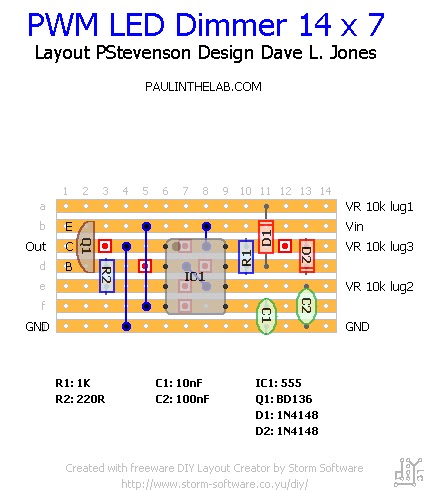
PWM LED Dimmer Stripboard VeroBoard Layout (Orig. By Dave L. Jones)
Dave Jones did a cool little circuit using a 555 to dim the LEDs on his Mantis microscope. Obviously this little circuit has a lot of uses so I thought I would make a little stripboard layout for it.
There isn't much to say about it as it has already been covered in his video (linked below)
so here you go.
Friday, 2 November 2012
Low Battery Indicator ( 9v ) Stripboard Veroboard Layout
I was in the middle of designing a little 9volt battery operated music thing and I thought it would be nice to have a little battery indicator to tell me when it was getting low.
Once I made it up I thought it might be a cool little thing to share on here so you could add it into stuff like guitar FX and so on.
it has 3 states:
1. if the battery is good then the LED doesn't light
2. between 7.5v and 6.4v the LED flashes to warn you it's getting low
3. below 6.4v the LED stays lit
I know there are specific ICs for this purpose however I like making my own "solutions"
Anyway hope you like it.
Thursday, 4 October 2012
Flux Capacitor LED Decoration Stripboard Veroboard Layout
for fans of Back To The Future - or LEDs
I know this isn't exactly like the real thing however that would involve crux tubes and so on and I doubt many people who read my site want to piss about with 10,000 volt supplies. Anyway it's pretty much for my halloween/christmas/bonfire night decoration collection.
as you can see I have included a layout for the actual display board, although it looks like the LEDs maybe abit too spaced out, in practice they wouldn't fit when they are closer together. However should you just want to use the display board I think that each transistor can drive quite a few LEDs (I think the 2N3904s are rated at 100mA)
As it stands the circuit draws roughly 5mA
The last thing I want to mention is the odd value electrolytic (well odd to some) it is 470nf however you can use a none polarized version it just happened that I have both kinds and the electrolytic takes up less space
I also included a little video to show you what it does. HERE
Paul in the
Lab is here to help
Everyone that's into electronics
Always feel free to
Seek my advice
Either using the
Contact button or my email
Lately I am always at the computer because
I am designing stuff for the site though I did buy a new
Camera recently it's pretty cool. I remember the first thing I built was the
Knight rider LED scanner which I uploaded
To the site a few days ago, remember if you need to know
How to do something
Even if you think it's
Abit of a stupid question just ask, I
Don't mind. We all had to
Start somewhere.
I know this isn't exactly like the real thing however that would involve crux tubes and so on and I doubt many people who read my site want to piss about with 10,000 volt supplies. Anyway it's pretty much for my halloween/christmas/bonfire night decoration collection.
as you can see I have included a layout for the actual display board, although it looks like the LEDs maybe abit too spaced out, in practice they wouldn't fit when they are closer together. However should you just want to use the display board I think that each transistor can drive quite a few LEDs (I think the 2N3904s are rated at 100mA)
As it stands the circuit draws roughly 5mA
The last thing I want to mention is the odd value electrolytic (well odd to some) it is 470nf however you can use a none polarized version it just happened that I have both kinds and the electrolytic takes up less space
I also included a little video to show you what it does. HERE
Paul in the
Lab is here to help
Everyone that's into electronics
Always feel free to
Seek my advice
Either using the
Contact button or my email
Lately I am always at the computer because
I am designing stuff for the site though I did buy a new
Camera recently it's pretty cool. I remember the first thing I built was the
Knight rider LED scanner which I uploaded
To the site a few days ago, remember if you need to know
How to do something
Even if you think it's
Abit of a stupid question just ask, I
Don't mind. We all had to
Start somewhere.
Thursday, 20 September 2012
Fading LEDs / Eyes for Halloween decorations stripboard veroboard layout
The inspiration for this little circuit with Halloween approaching was a post I saw made on this Thrifty Crafty Girl
basically the girl had an idea of putting glow sticks in toilet rolls with eyes cut out to leave in bushes however I thought it would be cool to add an electronic element to it.
so I made a little circuit that will make LEDs fade in and out - they will go in and out of sync and will look pretty dam creepy
Anyway this one quite cheap to make circuit will "power" 4 toilet roll monsters - 2 LEDs per toilet roll or whatever you want to put "eyes" or LEDs in
below is a video of it in action
Paul in the
Lab is here to help
Everyone that's into electronics
Always feel free to
Seek my advice
Either using the
Contact button or my email
Lately I am always at the computer because
I am designing stuff for the site though I did buy a new
Camera recently it's pretty cool. I remember the first thing I built was the
Knight rider LED scanner which I uploaded
To the site a few days ago, remember if you need to know
How to do something
Even if you think it's
Abit of a stupid question just ask, I
Don't mind. We all had to
Start somewhere.
Wednesday, 29 August 2012
Knight Rider Kitt / Cylon LED Sequencer Stripboard Veroboard Layout
This is a cool little project I've been meaning to do for a long time. One which was so simple I kept putting it off.
Essentially this is a 8Hz (ish) squarewave generator attached to a decade counter - it counts upwards displaying each count on the next LED however the outputs are wired in such a way that instead of just going upwards it goes back downwards. it should be obvious when you look at the schematic how the thing works.
Anyway as the name suggests the LEDS go back and forth like the eye things on Cylons from battlestar galactica or the front panel on the car from knightrider. my older brother drives a taxi so I plan on using this to drive relays to big lamps and attach it to his car when he's next away.
This circuit is very useful outside of replicating old TV show LED things, you can use it to sequence pretty much anything using relays or even digital circuits and you don't have to use the 555 to do it automatically, you can replace that with a push switch circuit to the CD4017 Clock pin (14) and control a pedalboard for example
or maybe even make your house seem haunted by using it to remotely control appliances. I will include a simple Relay Driver below.
![]() |
| To use the CD4017 to drive a relay |
Thursday, 19 July 2012
LED Ring Oscillator Stripboard Veroboard Layout
This was kind of a rush thing I did today because I have a few projects awaiting various IC's which I can't publish yet but I haven't posted anything this week so I thought I would lash up a LED Ring Oscillator - I'm sure you've seen these things on the net in various guises, mine has increasing value resistors which basically makes the oscillator more predictable in the way it rotates and which LED starts first which was quite important for this as it's going to be part of a LED/LDR circuit
you'll notice that the schematic I've done isn't in my usual notebook format but instead I used a program from the CD off the front of a magazine called circuit wizard - it's okay for testing little circuits like this so I thought I would just upload the schematic I drew in that
anyway as usual the stripboard has been built up and it works - the rate is voltage controlled so the less voltage you feed into it the slowed the LEDs will light up - my favorite voltage is about 3.3v which is cool for uController projects that already have that voltage available - I've tested mine upto 16 volts but I couldn't go any further due to the capacitors I was using.
Monday, 25 June 2012
Constant Current Led Tester Stripboard Veroboard Layout
Not really much to say about this thing really except that when it is powered at it's optimum voltage (12v) it tests LEDs at about at a current you set with the 100k pot.
I made this because I have tons of LEDs in a component bin and not only did I not know if they worked but using this I can match them for brightness because I'm sick of projects looking half arsed with different brightness LEDs
The other LED based use is that when you buy lots of LEDs from a one-hung-low chinese source on eBay there can be the odd batch of crap ones and it's best to find out before you spend 4 hours troubleshooting a project only to find it was the LED that was bad.
Wednesday, 20 June 2012
Candle Flicker Stripboard Veroboard Layout
My candle flicker effect
I shall try and give a little explaination of this circuit as it is one that is pretty useful as a Random Number Generator.
what is happening is that there are 2 square wave oscillators giving outputs at different rates to each other
so when both inputs of the NAND gate "accidentally" hit a logic high the output is low this in turn goes into a further NAND gate configured as a inverter ie when both the inputs are a logic low the output is a logic high.
the CD4093 is a pretty useful IC - in this one circuit we have the CD4093 configured as 2 oscillators, a NAND gate and an Inverter.
the Inverter output is then connected to a PNP transistor which switches on the LED when the logic output is low on the inverter.
using a PNP in this manner is how I included an indicator LED on my Atomic Frequency Standard as it outputs a Logic low when it locks in.
so anyway the CD4093 NAND Gate basically boils down to the following statement:
Output of a NAND Gate = 1, if any of the inputs = 0
0, if all of the inputs = 1
so anyway, boring crap aside - this little project emulates the flicker of a candle, it works best in the dark of course. As you will notice there is a second LED output, this is basically just a dimly lit LED I added to because a real candle doesn't turn on and off when it flickers, so if you hot glue them together then you get a more realistic flicker.
I shall try and give a little explaination of this circuit as it is one that is pretty useful as a Random Number Generator.
what is happening is that there are 2 square wave oscillators giving outputs at different rates to each other
so when both inputs of the NAND gate "accidentally" hit a logic high the output is low this in turn goes into a further NAND gate configured as a inverter ie when both the inputs are a logic low the output is a logic high.
the CD4093 is a pretty useful IC - in this one circuit we have the CD4093 configured as 2 oscillators, a NAND gate and an Inverter.
the Inverter output is then connected to a PNP transistor which switches on the LED when the logic output is low on the inverter.
using a PNP in this manner is how I included an indicator LED on my Atomic Frequency Standard as it outputs a Logic low when it locks in.
so anyway the CD4093 NAND Gate basically boils down to the following statement:
Output of a NAND Gate = 1, if any of the inputs = 0
0, if all of the inputs = 1
so anyway, boring crap aside - this little project emulates the flicker of a candle, it works best in the dark of course. As you will notice there is a second LED output, this is basically just a dimly lit LED I added to because a real candle doesn't turn on and off when it flickers, so if you hot glue them together then you get a more realistic flicker.
Saturday, 16 June 2012
LM3914 Voltage Monitor Stripboard Veroboard Layout
This is pretty much a datasheet circuit that I put onto stripboard
it has a monitor LED that turns off when it drops below 8 volts however by changing the placement of the resistor you can make the LED go out at any voltage for example if moved the resistor leg from pin 12 on the IC to pin 14 on the IC the LED would turn off when it drops below 5volts
Friday, 8 June 2012
Decision Maker With Slow Down Veroboard Stripboard
I've wanted to make one of these for a while, I am terrible at making decisions - if someone asks me anything where I need to make a decision I freeze up so over the years I've made various yes/no machines but they were never quite right because they didn't slow down, they just stopped.
This is quite a simple little circuit, so simple I don't know why people haven't done it before - sure there are heads or tails type decision makers out there but they light up and stop when you release the switch where as this one slows down to a stop which feels more random than the other method.
the main difference between this circuit and the usual heads and tails circuit (which I got from my 130 in one electronics project lab) is that this one charges the 22u capacitor which discharges through Q1 basically lowering the voltage to the 555 oscillator, as the voltage lowers - the oscillation gets slower and as it depletes it stops on red or green - or whichever colours you choose
when you turn it on for the first time you'll notice that one of the lights are lit - this is normal.
the explanation for this is that the CD4013 is a dual integrated flip flop circuit so it's always in one state or the other - it usually starts up in the same state every time.
when you press the push to make switch both LEDs will light up, maybe with a little flicker and once you depress the switch they will start to slow down till they make their choice.
operating voltage is between about 6 - 9 volts any lower it will tend to favor one state over the other.
C5 - in the schematic, this was left out of the stripboard because it's not really needed so don't worry about this. I thought there might be an issue with DC hum but there wasn't
TRANSISTORs - Although I stated BC549s in the stripboard, you can use most general purpose transistors like 2N3904s for example.
| my rather unimpressive boxed up version |
Friday, 1 June 2012
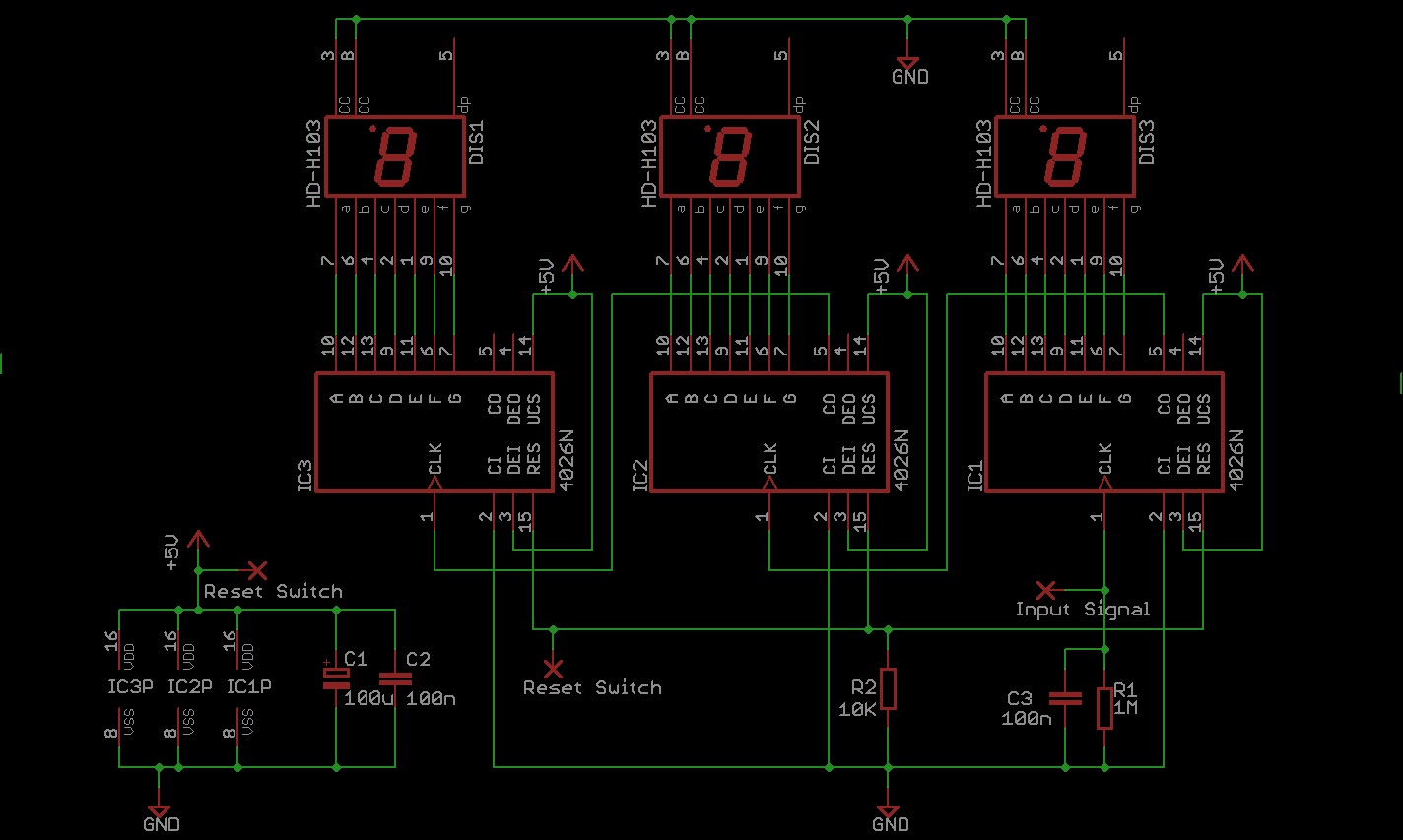
LED Display UP Counter Stripboard Veroboard (CD4026)
I wanted a counter that would basically count from a input signal, such as a reed relay to count the turns when winding a transformer or inductor for example. so I came up with this. I limited it to 3 digits (so it counts up to 999) because I only had veroboard big enough for that many but technically I don't think there is a limit to how many you can cascade because the CD4026 basically counts to 9 and sends out a clock signal on ten to the CLK in on the next chip
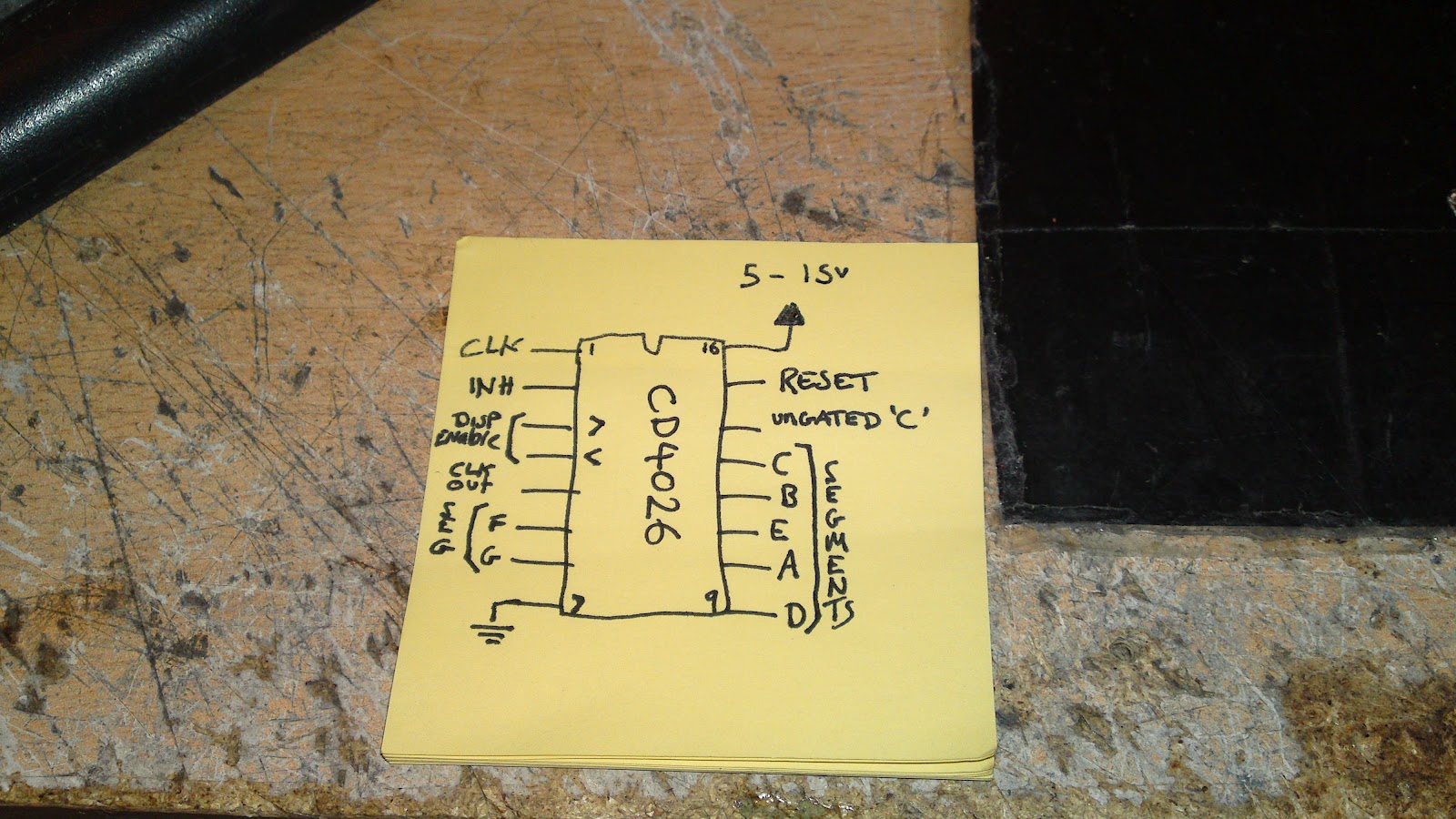
quite a simple circuit in theory but a pain in the arse with the jumpers and stuff, in order to try and save space I made jumper rails with little wire hooks which I've drawn on a little post-it note to try to show you what I mean, though I do tend to put the jumper a lot closer to the board than the diagram shows of course!
while building this up, I came across the issue where if I touched it, it would start counting up rapidally - this was because my body was acting as an antenna for 60Hz mains hum which can be an issue sometimes so I added a little R C bit to stop this and this also served to make it reliable when using a push-to-make switch to count on it.
if you want the exact LED displays I used it was this one LED DISPLAY but any common cathode display will do as long as the pinout is the same (shown below
Subscribe to:
Comments (Atom)