Welcome - Please Read

Welcome. I wanted to provide stripboard layouts I've made to help people new to electronics and even the more experienced get into different aspects of electronics.

I verify the layouts before I post them.

My Facebook Group: www.facebook.com/StripboardLayouts - Please Add For Updates!
My Twitter Thing: @InSonicBloom

Showing posts with label Display. Show all posts

Saturday, 16 February 2013

Self Powered 9 Volt Bar LED Battery Tester LM3914 Stripboard Veroboard Layout


another cool little voltage monitor but I had some requirements - I wanted it to be self powered and have an onboard load so I could check any 9 volt battery with it.
this is for a active pickup system so the self powered part of the design wasn't hard to factor in as usable voltage is around 5 ish volts in the EMG's I have.

and Last of all I wanted to use the LM3914 (DATASHEET) cause I've got loads of them from another project I never got around to doing.

I used a 82 ohm resistor (switched in by pressing the push to make switch) this will allow you to test the battery under a normal load which will give you a better indication of the batterys chargethe 82ohm resistor draws almost 110mA

I have done a circuit like this before which was a 0 - 10v voltage monitor (HERE) but the difference between that one and this is that this one is powered by the battery you're testing and the other one though more accurate needs a second power supply.


Wednesday, 29 August 2012

Knight Rider Kitt / Cylon LED Sequencer Stripboard Veroboard Layout


This is a cool little project I've been meaning to do for a long time. One which was so simple I kept putting it off.
Essentially this is a 8Hz (ish) squarewave generator attached to a decade counter - it counts upwards displaying each count on the next LED however the outputs are wired in such a way that instead of just going upwards it goes back downwards. it should be obvious when you look at the schematic how the thing works.

Anyway as the name suggests the LEDS go back and forth like the eye things on Cylons from battlestar galactica or the front panel on the car from knightrider. my older brother drives a taxi so I plan on using this to drive relays to big lamps and attach it to his car when he's next away.

This circuit is very useful outside of replicating old TV show LED things, you can use it to sequence pretty much anything using relays or even digital circuits and you don't have to use the 555 to do it automatically, you can replace that with a push switch circuit to the CD4017 Clock pin (14) and control a pedalboard for example
or maybe even make your house seem haunted by using it to remotely control appliances. I will include a simple Relay Driver below.


To use the CD4017 to drive a relay


Saturday, 16 June 2012

LM3914 Voltage Monitor Stripboard Veroboard Layout


This is pretty much a datasheet circuit that I put onto stripboard
it has a monitor LED that turns off when it drops below 8 volts however by changing the placement of the resistor you can make the LED go out at any voltage for example if moved the resistor leg from pin 12 on the IC to pin 14 on the IC the LED would turn off when it drops below 5volts


Wednesday, 13 June 2012

A Word On My Schematics and a 10 Hour Timer


Some of you older people (my age and older) may notice that some of my schematics resemble that of the old Forest Mimms schematics IE, drawn on graph paper. This, of course is on purpose.

When I was growing up I would often spend a lot of time in the electronics shop Tandy (Radio Shack in the US), it had actually gotten to the point where the shop assistants knew me (I was about 7) and would even look after me while my mam went shopping. The electronics educational books they had were all the forest mimms ones so they'd let me sit in the corner reading them so I have a lot of fond memories attached to the Forest Mimms books which is why as an alternative to drawing my circuits out in EAGLE (which I have with some of them) I would pay homage to Forest Mimms and use his method of hand drawing schematics on graph paper. not only that but it really is a great way of drawing schematics. using a CAD program is all well and good but it takes longer and you end up with computer blindness if you do lots at once.

The one little bit I've added to make it my own and because when reading schematics I hate having to look them up, is adding little pinout drawings of any discretes and/or ICs used

Anyway back in school I designed this little circuit after my dad moaned at me for being on the phone to my girlfriend of the time for too long. there's no veroboard layout because I did this with wire wrap - in fact it was just not practical to use stripboard for this circuit because it would have ended up being hundreds of jumpers.


Friday, 1 June 2012

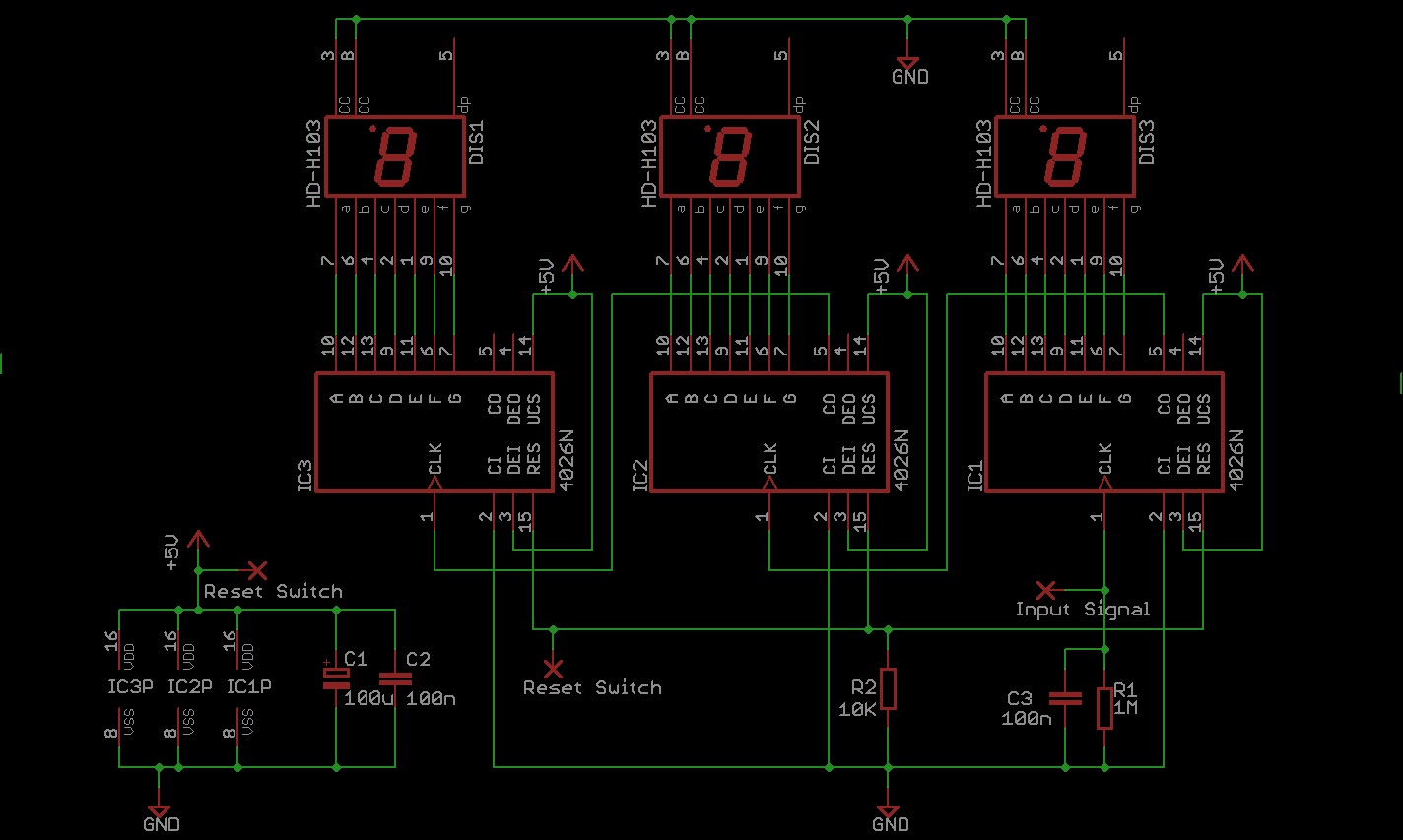
LED Display UP Counter Stripboard Veroboard (CD4026)


I wanted a counter that would basically count from a input signal, such as a reed relay to count the turns when winding a transformer or inductor for example. so I came up with this. I limited it to 3 digits (so it counts up to 999) because I only had veroboard big enough for that many but technically I don't think there is a limit to how many you can cascade because the CD4026 basically counts to 9 and sends out a clock signal on ten to the CLK in on the next chip

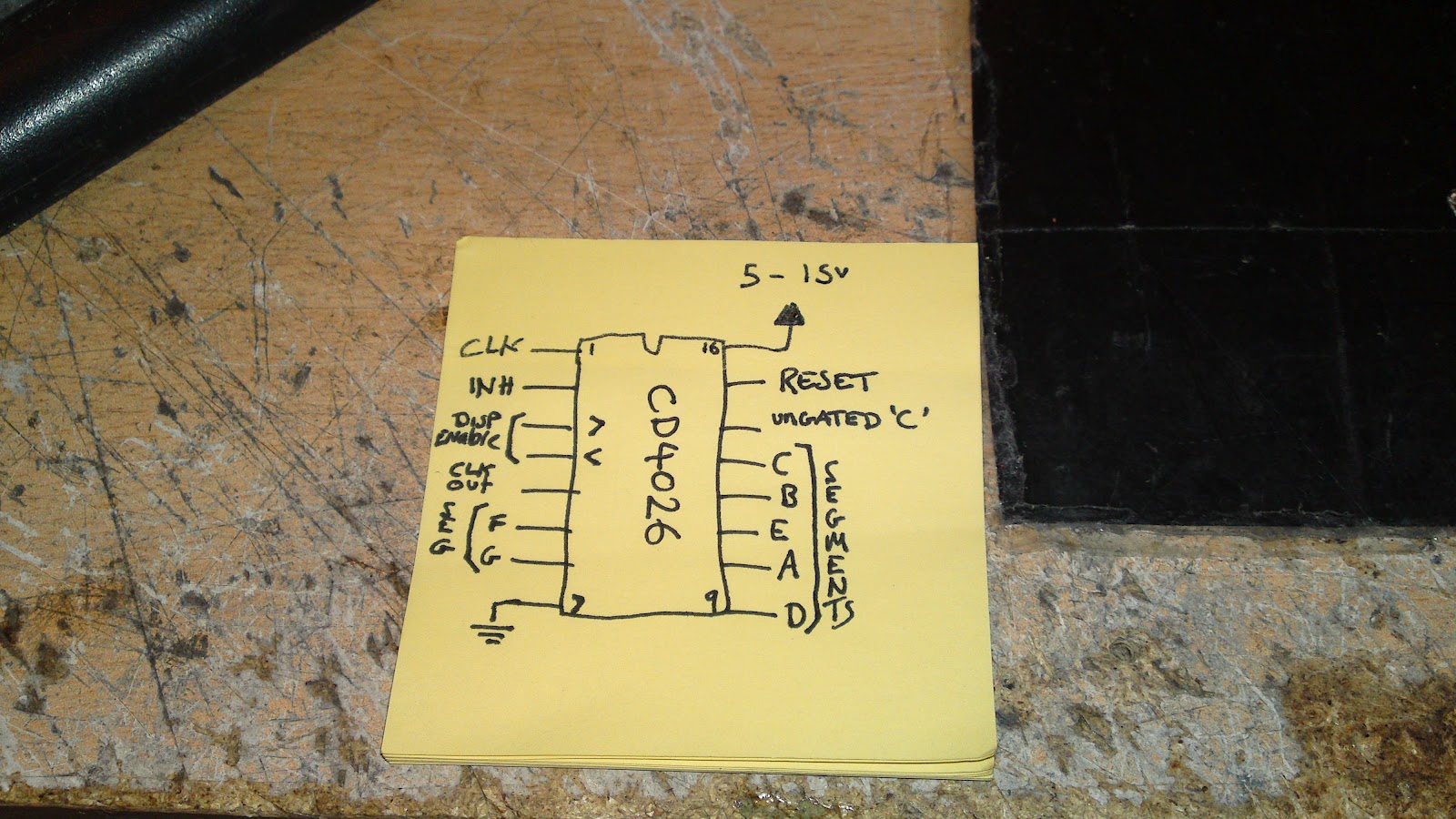
quite a simple circuit in theory but a pain in the arse with the jumpers and stuff, in order to try and save space I made jumper rails  with little wire hooks which I've drawn on a little post-it note to try to show you what I mean, though I do tend to put the jumper a lot closer to the board than the diagram shows of course!

while building this up, I came across the issue where if I touched it, it would start counting up rapidally - this was because my body was acting as an antenna for 60Hz mains hum which can be an issue sometimes so I added a little R C bit to stop this and this also served to make it reliable when using a push-to-make switch to count on it.

if you want the exact LED displays I used it was this one LED DISPLAY but any common cathode display will do as long as the pinout is the same (shown below


Wednesday, 2 May 2012

DC 0-19.99V Blue LCD Digital Volt Panel Meter Voltmeter Review


Originally this had a glowing report, it worked well and was accurate - the original one was broken and so they sent me a new one HOWEVER
once I got the new one, I did this review and put it in a box for use at a later date.
After someone got in touch with me asking me for the connections (they don't provide them) I thought I would get it out so I could let them know.

The LED backlight lit up, then nothing else happened - I triple checked everything and still nothing.
so about 7 months stuck in a box waiting to be used has some way made it stop working.
the box was not thrown,dropped or mistreated - it was an ESD safe container. So I am going to contact the seller (who I linked below this) let them know it's shit and give them opportunity to explain - 2 failing through no fault of my own is completely unacceptable.  
 HERE


Monday, 30 April 2012

7107 LED Voltmeter Stripboard Veroboard

based largely on articles in The Art Of Electronics I came up with this layout for a DVM based on the ICL7107 DAC I ended up doing 2 different layouts - one with a built in power supply to give me the +/- 5v needed and one that is just the meter circuitry alone.

in the Datasheet - the 7107 calls for the use of a 100pf capacitor however I found this to be far too slow at responding to a multiturn pot in a power supply so I replaced this with a 10pf capacitor which was much much better - meaning of course you don't have to mess about with trying to get accurate readings from the adjustable power supply (if you use it in one) if you build it - try to ignore the displays I've put on the first picture - they were for my reference and it was possibly a very specific display (I tend to use salvaged junk)

I've also included a couple of pictures of things I've used it in.

Add caption
Display wiring layout