Pages
Welcome - Please Read
Welcome. I wanted to provide stripboard layouts I've made to help people new to electronics and even the more experienced get into different aspects of electronics.
I verify the layouts before I post them.
My Facebook Group: www.facebook.com/StripboardLayouts - Please Add For Updates!
My Twitter Thing: @InSonicBloom
I verify the layouts before I post them.
My Facebook Group: www.facebook.com/StripboardLayouts - Please Add For Updates!
My Twitter Thing: @InSonicBloom
Monday, 30 April 2012
Mains Finder Stripboard Veroboard
a quick brutal mains finder stick thing - in close proximity to mains it will cause the LED to flash - I've used a weird type of layout in order to stick it in a tube
Buffered Y Splitter Stripboard Veroboard
as an engineer of music one of my biggest frustrations has always been guitarists and "EQ creeping" because they never realize that to get the best results through a microphone you have to severely reduce the EQ settings that you would normally use because what you hear from across the room is much different to what a microphone hears at the sound source - so what happens is that you set the amplifier up for recording, the guitarist would think "that doesn't sound like it normally does, I better adjust it because it won't sound good on the recording" and usually when you aren't looking they go over to their amplifier and turn the mid down and the treble and bass up this is the phenomena of EQ creeping, it becomes a problem when you set up everything to sound good on a recording only to find after recording a whole ton of tracks it isn't to be a nightmare of EQing because of the EQ creeping that has gone on.
so in order to combat this I made a simple little Y box (or Why do they not listen box) which I use without their knowledge so that it records whatever turd they think sounds good from the amp and a separate signal directly from the guitar allowing me to set up an amplifier after they have pissed off to tell their mates how they "laid down some sweet tracks today and it's going to sound awesome cause I helped engineer it"
so if you have ever been annoyed by "musicians" using the practice of EQ creeping - this is for you.
it needs to be buffered because a very low voltage signal is being split to 2 outputs
so in order to combat this I made a simple little Y box (or Why do they not listen box) which I use without their knowledge so that it records whatever turd they think sounds good from the amp and a separate signal directly from the guitar allowing me to set up an amplifier after they have pissed off to tell their mates how they "laid down some sweet tracks today and it's going to sound awesome cause I helped engineer it"
so if you have ever been annoyed by "musicians" using the practice of EQ creeping - this is for you.
it needs to be buffered because a very low voltage signal is being split to 2 outputs
Theremin Stripboard Veroboard
quite a nice sounding little theremin - I even had PCBs made up for this one cause I loved it so much but for you here are the veros.
make sure that you do not ground the antenna by attaching the antenna to a metal project box like I accidently did cause it won't work, it is advisable to remove
all unused copper tracks to reduce any noise.
it only draws 65mA so you can use one of the smaller transistor sized voltage regulators with no heat issues.
make sure that you do not ground the antenna by attaching the antenna to a metal project box like I accidently did cause it won't work, it is advisable to remove
all unused copper tracks to reduce any noise.
it only draws 65mA so you can use one of the smaller transistor sized voltage regulators with no heat issues.
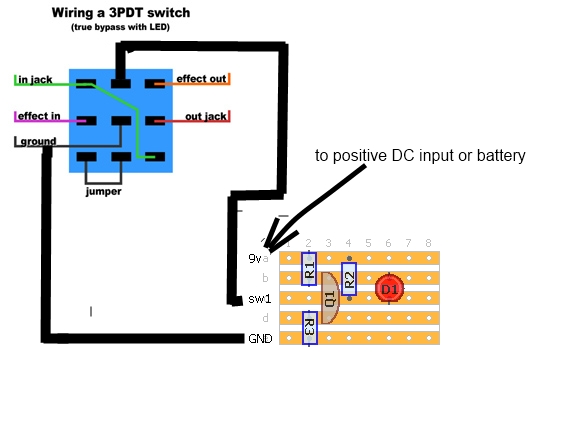
Red On Green Off for selector swtiches
a Quick little circuit - essentially it is an inverter which changes the polarity depending on the state of the switch, as I used it in a guitar effect primarily (quite a few other things since) I made a few pictures up to show how to connect it to a guitar pedal switch
Balanced to Line Microphone Preamp VeroBoard Stripboard
this is a nice high quality microphone preamp without all the added audiowank you usually see on these things - it uses quite expensive parts mainly because I got them as free samples from Texas Instruments.
I recorded a few songs with it - acoustic ones in order to show what it's like on acoustic guitars because that's where it excels
you can of course add phantom power to this however you need to add it pre- the diodes (they are there to protect the instrument amplifier IC) and you also need to make the 2 input caps (C1 C2) non polarized ones
I recorded a few songs with it - acoustic ones in order to show what it's like on acoustic guitars because that's where it excels
you can of course add phantom power to this however you need to add it pre- the diodes (they are there to protect the instrument amplifier IC) and you also need to make the 2 input caps (C1 C2) non polarized ones
Boss OD1 14 Pin Version Stripboard Veroboard
a guitar overdrive, quite a nice one - it uses a quad op-amp this buffers the input and output signal before/after it's passed through the overdrive which makes your guitar quite responsive but not with over the top overdrive.
this is one someone asked me to make for them - they wanted the "14 pin version" and not the "8 Pin version" basically Boss decided to reissue this pedal without the buffer parts - most probably because the op-amp they used had a none standard pinout to a jellybean one like a LM324 and instead of redesigning the board to use a different quad they redesigned the board to use a dual op-amp, I'm not entirely sure what the thinking was there but here is my version which is a quad op-amp version to use a normal quad op-amp.
IR Flip Flop switch Stripboard Veroboard
this is a little design I did when trying to figure out a way to turn the light on and off from across the room with a remote control, the drawback to it is that it reacts to any IR remotes but after I made this I replaced the sensor with a hacked off bit of dvd player (the bit with the IR sensor stuff in it) so it now only responds to a few buttons on the remote that belonged to the old DVD player.
for me solutions are better when they are free - I don't care if it looks like shit.
Atomic Clock
just a small "on a whim" eBay purchase - a rubidium clock which was (literately) sawn off an old mobile phone tower.
not really much in the way of electronics all I built were power supplies really but I think it's a cool little project and I use it to sync my midi/digital equipment - not that you need an atomic clock to do that but it cost £40 and all those weird audiophiles will love it.
on the datasheet for this thing, it had a note saying that it's locked into it's super-accurateness when the output goes low on the indicator output. so I made a little transistor switch to light an LED when it goes low
edit: whilst looking up some info on RF I came across this site which has some brilliant information on how to adapt your own version of this very atomic standard Rubidium Standard
Technical Manual
not really much in the way of electronics all I built were power supplies really but I think it's a cool little project and I use it to sync my midi/digital equipment - not that you need an atomic clock to do that but it cost £40 and all those weird audiophiles will love it.
on the datasheet for this thing, it had a note saying that it's locked into it's super-accurateness when the output goes low on the indicator output. so I made a little transistor switch to light an LED when it goes low
edit: whilst looking up some info on RF I came across this site which has some brilliant information on how to adapt your own version of this very atomic standard Rubidium Standard
Technical Manual
Constant Current Dummy Load VeroBoard Stripboard Veroboard
Similar to the one Dave uses
7107 LED Voltmeter Stripboard Veroboard
based largely on articles in The Art Of Electronics I came up with this layout for a DVM based on the ICL7107 DAC I ended up doing 2 different layouts - one with a built in power supply to give me the +/- 5v needed and one that is just the meter circuitry alone.
in the Datasheet - the 7107 calls for the use of a 100pf capacitor however I found this to be far too slow at responding to a multiturn pot in a power supply so I replaced this with a 10pf capacitor which was much much better - meaning of course you don't have to mess about with trying to get accurate readings from the adjustable power supply (if you use it in one) if you build it - try to ignore the displays I've put on the first picture - they were for my reference and it was possibly a very specific display (I tend to use salvaged junk)
I've also included a couple of pictures of things I've used it in.
in the Datasheet - the 7107 calls for the use of a 100pf capacitor however I found this to be far too slow at responding to a multiturn pot in a power supply so I replaced this with a 10pf capacitor which was much much better - meaning of course you don't have to mess about with trying to get accurate readings from the adjustable power supply (if you use it in one) if you build it - try to ignore the displays I've put on the first picture - they were for my reference and it was possibly a very specific display (I tend to use salvaged junk)
I've also included a couple of pictures of things I've used it in.
![]() |
| Add caption |
![]() | |
| Display wiring layout |
Subscribe to:
Posts (Atom)